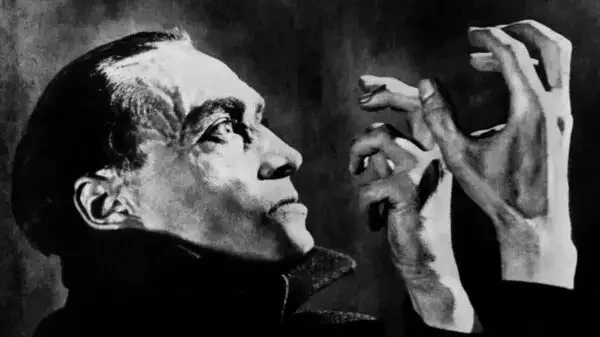
German Expressionism
0
Films
0 min.
Read Time
1.7k
Views
Contents
Introduction: German Expressionism
At the beginning of the 20th century, the First World War (1914-1918) changed all of Europe. European countries entered a process of change that will shape our day in terms of matters such as economy, sociology, science, trade, industry and art. Cinema, which was still in its early stages at the time, became one of the main art disciplines that underwent this change. Cinema was permanently burdened with the effects of the First World War. German Expressionism was one of the movements that best conveyed this change experienced in cinema.
BM
Bahadır Mahmut
Curator
Related Movements & Themes
14k reads
Kara Filmler (Film Noir) Listesi
120k reads
Klasik Filmler Listesi
What Is German Expressionism?
German Expressionism is a film movement that emerged with films that were subjectively interpreted and conveyed with extreme depictions by film directors in Germany, which were devastated in many ways by the First World War. Expressionist films have permanently determined the method for expressing emotions such as strangeness, weirdness and uncertainty that are difficult to describe.
Origin of the Term Dışavurumculuk
Expressionism originated primarily in Northern Europe in the field of poetry and painting in the late 19th and early 20th centuries. Expressionist works present the world only from a subjective perspective of the artist with their modernist features.
Erich Heckel – Two Men at a Table
Depictions are radically distorted to evoke feelings and ideas in the art lover. Artists’ ways of expressing the emotional experience they want to convey away from reality and objective approach, by using extremism have revealed the concept of expressionism.
Historical Development of the German Expressionism Movement
Background
At the beginning of the 20th century, German cinema first produced works within the Cinema of Attractions movement. Cinema of Attractions was a theory that emerged with the motivation of filmmakers to convey images that are not usually encountered in daily life in films in the late 19th and early 20th centuries. Filmmakers made low-cost but remarkable films within this movement and made a profit.
Film d’Art Film Studio
Over time, German films moved away from the Cinema of Attractions and became closer to another French film movement, “Film d’Art”. With the Film d’Art movement, adaptations of theatrical productions and literary works were filmed. Film d’Art films belonged more to the theatre than the cinema, as they did not use the capabilities of the cinema. While the productions were copied from the theatre, the audience experience was also copied from the same source.
Although the Cinema of Attractions and Film d’Art movements were economically working models, Germany was going through a rapid change. German cinema lovers, filmmakers and directors were being driven away towards an area that was economically and psychologically not covered by these movements.
As the First World War approached, the German economy gradually contracted. Alongside the contraction of the economy, Germany became an increasingly isolated country. This affected the German people as well as the artists and filmmakers. The number of films shot gradually decreased. Interest in German further decreased.
The Student of Prague
“The Student of Prague“, shot in 1913 just before the First World War, was an important production for German cinema. The film was interesting with its story reminiscent of Faust. But more importantly, the feeling of helplessness, weirdness, being trapped, and the method of conveying these feelings was innovative. The powerful depiction of “The Student of Prague” at low costs was an important opportunity for German cinema to overcome the crisis of the time.
Beginnings
In 1913, “The Student of Prague“, directed by Paul Wegener and Stellan Rye, was one of the first steps towards the transition to expressionist films. With “The Student of Prague”, German cinema gave the most important signal of its exit from the Film d’Art hegemony.
The First World War Period
Cinemas of European countries filming during the First World War were hit by the destruction of their infrastructure and facilities. Furthermore, countries’ film crews and film equipment were deployed on and behind the front lines to document the war. German, British, French, Russian and Italian cinemas could not produce films independently of the state for a very long time.
Universum Film – Aktien Gesellschaft logo
In 1916, the German government started to impose an embargo on all foreign films due to the increased anti-Germanism. In 1917, German cinema was commissioned by the German government to document the war and to shoot propaganda films. All German cinema studios, crews and equipment entered into the service of the German Supreme Army Command. The new structure that would dominate the German film industry for a long time was named Universum Film-Aktien Gesellschaft (UFA).
Main Period
With UFA, all studios, crews, equipment, filmmakers were centralized and turned into a single studio. UFA suddenly became the most important film producer in Europe due to its technical capabilities and continuous funding. While the number of films produced in Germany was 24 in 1914, this number increased to 130 in 1918 with the UFA. UFA’s high production capacity as well as the film shortage in the domestic market due to the embargo on foreign films had a significant effect on the increase in the number of films produced. After the war ended, UFA would become the world’s largest studio.
After the First World War
After Germany lost the war, the “The Weimar Republic” period, which would continue between 1918 and 1929, began. In this period, some new variables emerged that would trigger the German Expressionist films:
•
Millions of dead, wounded and crippled people
•
Psychologically broken society
•
Infrastructure deficiencies
•
Economic crisis, hyperinflation
•
Conflict and disagreement with the countries that won the war, and embargoes
In such a chaotic environment, the UFA’s situation was very promising for German cinema. The UFA, which was centralized and financed for war, no longer had to produce for war. With the films shot during the war, the interest of the society in German films also increased. All of these factors allowed Expressionist film directors to go further beyond the boundaries in their films. Friedrich Wilhelm Murnau, Fritz Lang, Robert Wiene would take expressionist cinema to the highest level with their unusual narration methods and innovative visual designs. But what really triggered German Expressionism had not yet happened.
UFA film set at the Templehof Studios
In 1920, Deutsche Eclair (Decla), an independent studio, shot “The Cabinet of Dr. Caligari” under the direction of Robert Wiene, using methods developed to overcome technical impossibilities. The movie was visually completely different from the films made until that day. The film succeeded in depictions made with make-up, light and shadows created with sharp border lines. In the film, 2-dimensional spaces and unreal perspectives were created by painting the decor with a light grey background with sharp lines in black. Again, with painting, light and shadows were created. With similar cinematographic by-passes, a masterpiece that changed the cinema was brought into being. “The Cabinet of Dr. Caligari” created reference points for the upcoming expressionist films with its allegorical story structure, set, decor, lighting, make-up, and costumes.
The number of Expressionist films increased in a very short time with the increase in society’s habit of going to movies, the funding of expressionist films by the UFA, and a reference film such as “The Cabinet of Dr. Caligari”.
Some of the most prominent examples of German Expressionist films emerged under the production of UFA.
•
Dr. Mabuse the Gambler (1922)
•
Die Nibelungen (1924)
•
The Last Laugh (1924)
•
Metropolis (1927)
•
Faust (1926)
…
Fritz Lang
The most important expressionist directors that UFA worked with in the early period were as follows: Ludwig Berger, Wilhelm Dieterle, Paul Czinner, Ewald André Dupont, Fritz Lang, Karl Grune, Ernst Lubitsch, Friedrich Wilhelm Murnau, Hanns Schwarz, Arthur Robison, Joe May, Paul L. Stein, Wilhelm Thiele.
During this period, Fritz Lang and Friedrich Wilhelm Murnau shaped German Expressionism and world cinema with their films, many of which were considered masterpieces.
Fritz Lang: M (1931), Dr. Mabuse, der Spieler (1922), Die Nibelungen: Siegfried (1924), Die Nibelungen: Kriemhild’s Revenge (1924), Metropolis (1927), The Testament of Dr. Mabuse (1933) …
Friedrich Wilhelm Murnau: Desire (1921), The Haunted Castle (1921), Nosferatu (1922), Phantom (1922), Faust (1926) …
Exceptions
Although the UFA played an important role in the production of expressionist films, it was a structure under the control of the government. UFA was a monopoly; its establishment was realized by closing, merging and expropriating several companies. The UFA could put pressure on and censor the directors to make propaganda films.
The End of the German Expressionism Movement
German cinema became even more known along with the atmosphere that normalized after the First World War. Expressionist directors made numerous films with their high productive abilities in the chaotic post-war environment. The recognition of Expressionist films and their directors peaked after the lifting of the embargoes on Germany.
Germany’s re-opening to foreign countries after the First World War caused critical disadvantages in important matters for German cinema.
The exchange rate was stabilized after the agreements made on a global scale in order to restructure and finance Germany after the war. The stabilized exchange rate made it less expensive to import films than to produce them.
After the lifting of the embargoes, Hollywood films became more popular than German films in the German cinema market. The market shares of German films shrank.
The increasing obligations of the UFA after the agreements signed with the American Paramount and Metro-Goldwyn-Mayer caused the company to experience financial difficulties. The purpose of UFA’s agreements with American companies was to open up to the American market and the world, however, German cinema started to become American as a result of these agreements. Although it became one of the largest studios in the world after its merger with Decla, UFA’s film revenues did not meet expectations.
The economic independence and production capabilities of UFA, whose market share decreased, were negatively affected.
In the 1930s, German cinema, which survived the First World War with UFA, was tested with different dynamics this time. Along with UFA, the cinema industry also sank into an economic depression. Hollywood’s market shares in Germany expanded more than expected. The Nazi party, on the other hand, put pressure on the artists and tried to bring them into a new system of propaganda cinema.
In 1933, Adolf Hitler was appointed Chancellor of Germany. Joseph Goebbels was then brought to the 3rd Reich Ministry of Public Enlightenment and Propaganda (Reichsministerium für Volksaufklärung und Propaganda or Propagandaministerium). Goebbels and his team controlled all German media and art institutions, aiming to make their propaganda even stronger. The pressure that began to be exercised on filmmakers in the 1930s increased even more during this period. Many directors, writers, cinematographers, sound experts had to leave Germany due to pressure. Artists who left Germany preferred to go to Italy and France but mostly to America. During this period, famous names like Robert Siodmak, Billy Wilder, Otto Preminger, Paul Leni, F.W. Murnau left Germany. Fritz Lang immigrated to America and joined Paul Leni and F.W. Murnau.
German Cinema, which got stronger during the Weimar Period and did works beyond its age, lost its talented names. The shooting of expressionist films came to an end in a short time.
Characteristics of the German Expressionism Movement
The Cabinet of Dr. Caligari
The characteristics mentioned below form the framework of German Expressionism. There are not many films that could come close to “The Cabinet of Dr. Caligari”, which offered all of these features together. For this reason, “The Cabinet of Dr. Caligari” is qualified as the reference film of German Expressionism.
•
Films conveying feelings of pessimism, weirdness, and deprivation to the audience
•
Anti-hero or demonic characters being at the centre of the story
•
Criticism and allegorical structure in their stories
•
The subjecting perspective of the films towards the story being told
•
Exaggerated depictions in narration
•
The appearance of dementia, paranoia, obsession, insanity and hysterical cases in films
•
Geometric shapes, perspective, reflections and the enabling frames, mirrors, rails and stairs all becoming a part of the composition
•
Including sharp shadows and light transitions in the frame
•
Camera movements
•
Use of special effects
Influences of the German Expressionism Movement
German Expressionism emerged and went out of existence at a critical time. Between the two world wars, it undertook all the economic crises, pessimism, polarized nature and social conflicts of the period. Extremely dark and absurd films were shot, which would later become known as cults and classics. This showed points where cinema’s narrative forms could expand. The talents of cinema were reinvented. Expressionism found itself a prominent place in Film Noir with the horror and thriller film genres.
Horror cinema
Horror cinema or many techniques used today for scenes with an element of horror first appeared in German Expressionist films. Sharp lights and shadows, surreal characters, dementia, absurd camera angles and many more soon became indispensable elements of horror films.
Film Noir
With the effects of the Second World War, many filmmakers migrated from Europe, especially Germany, to America. Just as German Expressionism turned into a form of self-expression of German filmmakers during the First World War, it would also form the basis of Film Noir, the method of expressing the traumas that American filmmakers would experience after the Second World War.
The Lady from Shanghai
Billy Wilder, Otto Preminger, Alfred Hitchcock, Orson Welles, Carol Reed, and Michael Curtiz are directors who best revealed the influence of expressionism with their noir films.
Best German Expressionism Directors
•
Fritz Lang
•
Carl Theodor Dreyer
•
Robert Reinert
•
Friedrich Wilhelm Murnau
•
Paul Wegener ve Stellan Rye
Best German Expressionism Films
References and Further Reading
Wikipedia (Cinema)
UNIVERSITY OF MARYLAND
Wikipedia (Art)
BFI
Selection List
Curator's Order
1. The Golem: How He Came into the World (1920) – Carl Boese, Paul Wegener
In the dark streets of 16th-century Prague, a sense of helplessness looms in the narrow, eerie corners of the Jewish quarter. Rabbi Loew resolves to breathe life into the earth to stand against the impending persecution. The shadow-drenched aesthetic of German Expressionism transforms this silent film experience into a truly unsettling nightmare.
A colossal creature, shaped by clay, magic, and forgotten rituals, awakens. One of the earliest examples of the fantasy and horror genres, the film brings the spirit of the era to the screen. The tension created by this uncontrolled power continues to echo through Prague’s cobblestone streets.
2. The Student of Prague (1913) – Stellan Rye
In the misty streets of nineteenth-century Prague, Balduin, a poor student, paces the sidewalks. As the walls of class division intersect with aristocratic circles, ownership of the shadows becomes a matter of dispute. Directed by Stellan Rye, this classic of German Expressionism presents the audience with a dark Gothic fantasy. That dangerous bargain struck with a mysterious stranger transforms into a completely different nightmare as the reflection in the mirror takes on a life of its own.
3. Tartuffe (1926) – F. W. Murnau
The silent film scenes unfolding on a screen illuminated by dim lights reveal, layer by layer, the hypocrisy that has descended upon a family. In this blend of drama and comedy, in which F. W. Murnau brings Molière’s timeless text to the cinema, he examines the dark yet comical twists and turns of the human soul. The tension between a cunning governess in pursuit of an inheritance and the family cornered by her is reflected on the silver screen through the camera’s meticulous framing. The fine line between authenticity and deception draws the audience into the cinematic atmosphere of the era, while the performance on screen engages in a dangerous dance with reality itself.
4. Die Nibelungen: Kriemhild's Revenge (1924) – Fritz Lang
An oath of vengeance echoing among the stone walls of the fifth century grows with a silent patience that gnaws at the mind. Fritz Lang creates a dark atmosphere infused with hints of Norse mythology in this epic tale. Kriemhild marries the Hun ruler Etzel to exact revenge on her husband’s killer.
The pale-faced kings of the Burgundian court set out for this perilous wedding, held in the middle of the steppe. The solemn narrative style of silent cinema casts the cold shadow of the approaching carnage from the very beginning.
5. Die Nibelungen: Siegfried (1924) – Fritz Lang
In the legendary landscape of the fifth century, a hero bathed in dragon’s blood enters through the gates of Worms. Directed by Fritz Lang, this magnificent adventure weaves an atmosphere of stone walls and frozen northern lands, drawing on the dark roots of Germanic mythology. Siegfried’s journey, which begins at the Burgundian court, brings the world of epic sagas and folk heroes to the silver screen. This journey toward Princess Kriemhild, combined with the monumental visual language of silent cinema, transports the viewer to the heart of an ancient myth.
6. The Last Laugh (1924) – F. W. Murnau
A life spent at the revolving door of a luxury hotel is shattered when the gold-embroidered uniform on his back is suddenly taken away. When the elderly doorman is dragged from the opulent ballrooms into the dark back alleys, he finds himself alone amid the gossip and scornful glances of an entire neighborhood.
F. W. Murnau depicts the shattering of old age and human dignity using the sharp shadows of German Expressionism. Amid rain-washed streets and smoldering cigars, the silent devastation caused by the loss of his job transforms the stooped figure on the character’s shoulders into a black-and-white portrait that whispers far more than words ever could.
7. Destiny (1921) – Fritz Lang
In the gloomy shadow of a quiet village inn, time suddenly stands still; the fiancé of the young woman sitting at a table with a stranger mysteriously vanishes at that very moment. Drawing on the darkest tones of German Expressionism, Fritz Lang draws the viewer into a tragic labyrinth that wanders the very edge of death. The woman, who knocks on death’s door to reclaim her lost lover, is forced to confront the mirror of her own fate within three separate tales set in different lands.
8. The Cabinet of Dr. Caligari (1920) – Robert Wiene
It all begins in the garden of a mental hospital where the streets wind haphazardly and the shadows stretch taller than a person. This black-and-white nightmare, directed by Robert Wiene, wanders through the darkest corners of German Expressionism, pulling the rug of reality out from under your feet. As Francis gets lost among his memories, he draws the viewer into a gloomy labyrinth.
The mysterious doctor in the carnival tent and Cesare, who lies in a death-like slumber, become ghostly pursuers of the murders that shatter the silence of the night. This suspense-filled drama and crime story, taking shape within the mind of an unreliable narrator, traps the viewer in a breathless atmosphere accompanied by geometric nightmares.
9. Warning Shadows (1923) – Arthur Robison
In the late nineteenth century, as winds of jealousy blow across the dining table of a lavish German mansion, four suitors who have set their sights on the host’s wife further heighten the tension within the room. In this dark drama by Arthur Robison, which blends elements of the fantastic, a mysterious shadow puppeteer invited into the salon stages a performance that will alter the fate of those at the table.
As the silhouettes on the screen grow larger, the grotesque shadows of German Expressionism begin to dance on the wall. This eerie nightmare presented by the performance is either a harbinger of impending disaster or merely a dangerous game played by the mind.
10. Phantom (1922) – F. W. Murnau
The ordinary life of a civil servant wandering aimlessly through streets not yet warmed by the sun is turned upside down by a speeding car. Directed by F. W. Murnau, this story—entwined with drama and romance—traces the path of a dangerous infatuation that takes root in the mind following a sudden accident.
The man, moving with listless steps through the streets, loses himself in pursuit of this obsessive passion growing within his mind. As reality and fantasy blur, the character’s descent into chaos transforms into a dark fairy tale.
11. Nosferatu (1922) – F. W. Murnau
In a desolate castle nestled in the rugged mountains of Transylvania, time flows like a pale shadow. F. W. Murnau’s gothic horror classic centers on the dark world a young man steps into while traveling for real estate business, and the eerie atmosphere that emanates from the very nature of silent cinema.
In this Gothic tale, enveloped by leaping shadows and shape-shifting nightmares, a wave of death and destruction rolls toward the shores, while the cold breath of a supernatural entity is felt on the viewer’s neck.
12. The Hands of Orlac (1924) – Robert Wiene
Waking up just before dawn amid the screeching of iron rails, Paris is clearing away the debris of a train wreck drenched in blood up to its neck. Meanwhile, world-renowned pianist Paul Orlac emerges from the wreckage, his hands free. Robert Wiene’s camera lets the shadows of German Expressionism seep drop by drop onto the white sheets in the hospital rooms.
When he learns whose fingers have been sewn onto his wrists, every object in the room turns into a silent executioner. As layers of mystery and suspense knot themselves around the pianist’s sweaty fingers on the keys, the mind begins to reject this strange organ transplant. Fear seeps in from the edge of the keyboard.
13. Nerves (1919) – Robert Reinert
As the ruins of war litter the streets of Munich, the restless atmosphere of 1919 weighs equally heavily on every segment of society. In the shadowy streets of German Expressionism, everyone—from factory owners to teachers—strives to navigate the boundaries of their own minds.
This silent film by Robert Reinert examines lives that have lost their way in the midst of a mass collapse. The accusations brought before the courts and the wave of anger sweeping through the streets lay the groundwork for a paranoia fueled by tension.
14. The Man Who Laughs (1928) – Paul Leni
It all begins with whispers in the palace corridors on that dark night when a nobleman who refused to kiss the king’s hand was brutally murdered. Paul Leni evokes the ruthless atmosphere of 1690 through the tragedy of a young man forced to live with a permanent smile etched on his face.
In the dusty, gothic world of street performances, where elements of drama and horror intertwine, the silent agony behind the clown’s mask grows ever deeper. As the crowds burst into laughter, this strange jester is left alone with the wreckage within himself.
15. Vampyr (1932) – Carl Theodor Dreyer
That foreign village, shrouded in the night’s mist, breathes under the weight of the supernatural. Allan Gray, a wanderer at heart, senses the darkness silently spreading as he steps into this gloomy inn. Carl Theodor Dreyer, tracing the trail of a Gothic nightmare, transforms the cinematic screen into an intermediate form where dreams and reality intertwine.
Cemeteries stretching in the shadow of an old castle and spinning windmills set the unsettling landscape of the narrative. Pale, bloodless faces and mysterious beings fuel the curse that has settled over the town. Amid the sharp contrast between black and white, a fluid sense of dread slowly envelops the viewer.
16. Waxworks (1924) – Leo Birinski, Paul Leni
Amid the carnival crowd, in a tent surrounded by the cold stares of wax figures, it all begins. The task is simple: a story will be written for each figure there. As the young poet pours the horror behind these dark portraits—taking shape at the tip of his pen—onto the page, he is drawn, along with Eva, the museum owner’s daughter, into a strange adventure where fantasy and reality blur. Wandering through the shadowy streets of German Expressionism and the deepest recesses of the human mind, this anthology masterfully blends elements of fantasy and horror. As the pen moves across the page, the text transforms into an eerie dream sequence stretching from the palace of Harun al-Rashid to the tyranny of Ivan the Terrible and the trap set by Jack the Ripper. The sense of reality slowly fades away.
17. Dr. Mabuse, the Gambler (1922) – Fritz Lang
In the shadow of the economic collapse and inflation engulfing the streets of Berlin, Dr. Mabuse—who dons a new mask at every turn—is weaving an invisible web. In this crime and thriller epic directed by Fritz Lang, we witness a dark mind game that ranges from stock market scams to hypnotic manipulation at the gambling tables.
As a master of disguise takes control of the city’s spirit through psychological tactics, Commissioner von Wenk tracks down the conspiracy through midnight operations. Carrying the German Expressionist aesthetic of silent cinema, this monumental narrative lays bare the mechanical workings of evil at the heart of the modern city.
18. Faust (1926) – F. W. Murnau
In a town where darkness envelops the streets and the plague is ravaging the people, he finds himself trapped in the shadow of Gretchen, an elderly alchemist nearing the end of a life woven with knowledge. F. W. Murnau’s camera brings the weaknesses of the human spirit and the stench of decaying flesh to the screen through the grotesque lines of German Expressionism.
That dangerous bargain with the devil begins with the promise of eternal youth, but the price is to set everything left behind ablaze. Drawing on mythology, this Gothic fantasy leaves the viewer in the midst of a breathless darkness at that ancient threshold where faith and greed collide.
19. Metropolis (1927) – Fritz Lang
There is a sharp divide between the comfortable life at the tops of massive skyscrapers and the world of those who keep the dark machinery turning beneath the ground. This German Expressionist classic by Fritz Lang brings to the silver screen people struggling to breathe in the shadow of massive machines and a class-based social structure. The tension between the exploited workers in the underground tunnels and the city’s rulers heralds an impending social explosion. Embracing the darkest tones of science fiction aesthetics, this dystopia lays bare—in a cold and detached tone—the wounds inflicted on the human spirit by an increasingly mechanized world.
20. M (1931) – Fritz Lang
The fear gripping the streets echoes through the dark silhouette of Weimar-era Berlin. In this classic thriller directed by Fritz Lang, the city’s underworld and police force join forces in a single hunt for a serial killer who targets children. The echoing whistles and shifting shadows in the city’s streets fuel the heavy atmosphere of German Expressionism.
On one side are detectives closing in on their target; on the other, organized crime networks seeking their own brand of justice. In this relentless chase where the hunted and the hunter become indistinguishable, the killer finds himself cornered at every street corner.
Related Movements & Themes
14k reads
Kara Filmler (Film Noir) Listesi
120k reads
Klasik Filmler Listesi
Home
Film
Curation
Criticism
Menu