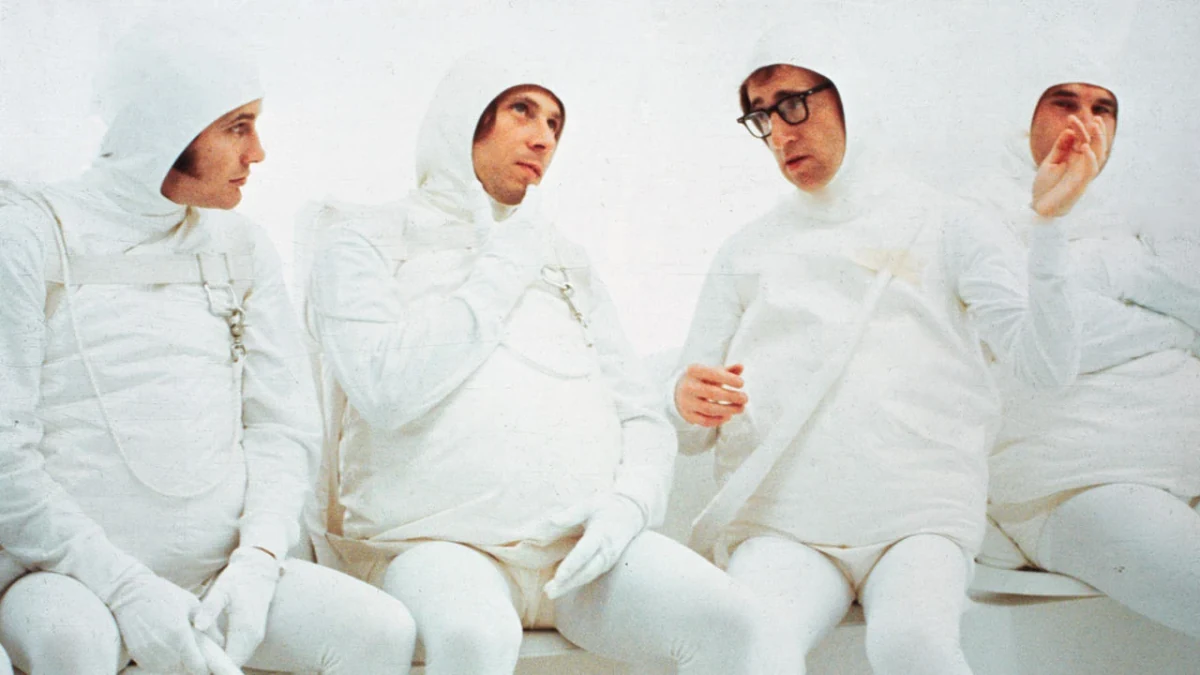
List of Absurdist Comedy and Humor Films
0
Films
0 min.
Read Time
0k
Views
Contents
Absurdist comedy films, which employ surrealism, irony, parody, and contrast as narrative techniques, have had such a significant impact that they have reshaped the definition of comedy, particularly in the era of modern cinema. This list of absurdist comedy films features the most notable examples of these films that have achieved cult status.
BM
Bahadır Mahmut
Curator
Related Movements & Themes
24k reads
Absürt Filmler Listesi
221k reads
Kült Filmler Listesi
The origins of the absurdist comedy can be traced back to the early 20th century. This genre gained immense popularity, particularly during the 1950s and 1960s. One of its earliest examples is the 1952 play *Waiting for Godot* by the renowned Irish writer and playwright Samuel Beckett. This play centers on characters who have no purpose other than waiting for an event that never comes. Beckett highlights the meaninglessness and absurdity of human existence.
*Waiting for Godot* by
Another key figure who had a significant influence on the absurd comedy genre is Eugene Ionesco. Lonesco’s works criticize the absurdity of a society where people act routinely without thinking. Works such as *The Bald Soprano* (1950) and *Rhinocéros* (1959) are fundamental examples of the absurd comedy genre.
Absurdist comedy films are a genre of humor that creates illogical situations and behaviors by focusing on events that defy everyday logic. The Marx Brothers’ 1933 film *Duck Soup* can be cited as a pioneer of this genre. The film tells a story of corruption. The economy of Freedonia, a country notorious for its corruption, depends on a donation to be made by Mrs. Taesdale. However, instead of making this donation, Mrs. Taesdale’s sister, Vera Claypool, is tasked with stealing letters from the country’s enemy, Sylvanian. The absurd scenes and dialogues in the film are among the best examples of the Marx Brothers’ masterful comedic style.
.embed-container { position: relative; padding-bottom: 56.25%; height: 0; overflow: hidden; max-width: 100%; } .embed-container iframe, .embed-container object, .embed-container embed { position: absolute; top: 0; left: 0; width: 100%; height: 100%; }
In addition, the film *Monty Python and the Holy Grail* (1975) is also one of the most important examples of the absurd comedy genre. Set in medieval England, the film adopts a fantastical, absurd comedic approach that breaks away from the rigid depictions of the Middle Ages typically found in the public imagination. The film *Airplane!* (1980), on the other hand, was inspired by the disaster movie genre. Focusing on the struggle for survival of passengers aboard a commercial airliner, it has become one of the most widely recognized examples of the genre in mainstream cinema.
The historical development of absurdist comedy films can be summarized as follows:
•
Pioneering period: The era of absurdist comedy films, which began in the early 1930s with the Marx Brothers’ *Duck Soup* (1933).
•
Golden Age: The golden age that began in the 1960s with the broadcast of the television show *Monty Python’s Flying Circus*. Films such as *Monty Python and the Holy Grail* (1975) and *Life of Brian* (1979), produced by the Monty Python team during this period, are among the most important examples of absurdist comedy.
•
Modern era: The period beginning in the 1980s is referred to as the modern era. Films from this era, such as *Airplane!* (1980), *The Naked Gun* (1988), and *Austin Powers: International Man of Mystery* (1997), are among the most important examples of absurdist comedy.
Techniques frequently used in absurdist comedy films include:
•
Surrealism: Scenes and dialogues that are detached from reality.
•
Parody: Sarcastic references to other films or pop culture products.
•
Irony: Scenes or dialogues that end with an unexpected twist.
•
Contrasts: The juxtaposition of opposing concepts.
Best Of
Selection List
Curator's Order
1. Monty Python and the Holy Grail (1975) – Terry Jones, Terry Gilliam
As King Arthur and his loyal squire traverse the English countryside without their horses, they find themselves struggling to gather the Knights of the Round Table amid the mud and absurdity. Directed by Terry Jones and Terry Gilliam, this anarchic comedy strips the quest for the Holy Grail of all its solemnity.
As sword fights devolve into absurd arguments with crippled black knights, even stepping through the gates of Camelot becomes a ridiculous adventure in and of itself. Historical sets and low-budget gags come together to completely shatter medieval mythology.
2. This Is Spinal Tap (1984) – Rob Reiner
Spinal Tap, England’s loudest metal band—which cranks its amplifiers’ volume knobs all the way up to eleven—is trying to make a splash on its U.S. tour. Directed by Rob Reiner, this mockumentary paints an absurd portrait of the music industry, filled with faded leather outfits, half-empty venues, and ego clashes. The aging rockers, trying to shine on stage while getting lost in the backstage hallways, have you laughing at every turn.
3. Buffet Froid (1979) – Bertrand Blier
The sense of emptiness echoing among Paris’s desolate concrete structures begins with Alphonse Tram’s footsteps. He neither remembers the crimes he has committed nor can he escape the absurdity around him. His loneliness grows exponentially in the concrete metro stations and deserted streets. He finds a neighbor: a police inspector who questions the monotony of life.
This black comedy by Bertrand Blier takes hold of the mind in the eerie midnight hours of Paris. In this unsettling universe where crime and chance are intertwined, the characters struggle with their own shadows.
4. Life of Brian (1979) – Terry Jones
In the dusty streets of Bethlehem, Brian—who is trying to lead an ordinary life in the shadow of the Roman Empire—suddenly finds himself cast as a false messiah, with crowds chasing after him. Directed by Terry Jones, this anarchic comedy satirizes the dogmas of antiquity and independence movements with absurd humor. Caught between his overprotective mother’s scolding, show-off Romans, and organized ignorance, Brian is right in the middle of a satire-filled chaos woven around the concept of faith. While tracing the origins of sacred texts, the film uses sharp humor to lay bare the masses’ desire for blind faith.
5. Eating Raoul (1982) – Paul Bartel
The stifling atmosphere of Los Angeles apartment buildings has long since overwhelmed a conservative couple. This black comedy by Paul Bartel centers on a bizarre coincidence that turns the ordinary lives of Paul and Mary—who are burning with desire to open their dream restaurant—upside down. As the inevitable corruption knocks on their door, transforming them from an innocent married couple into distant killers, everything slowly spirals out of control on this dark and absurd journey in which they become accomplices.
6. Zelig (1983) – Woody Allen
A man who has lost his identity wanders the turbulent streets of the 1920s. Leonard Zelig is a chameleon-like, inconspicuous figure who disguises himself as those around him in order to blend in with the crowd. Woody Allen masterfully employs the mockumentary format to construct this absurd world of humor.
Skillfully weaving through historical archive footage and old newsreels, the film examines the individual’s search for social belonging with a satirical edge. As Zelig’s face adapts to every mold, capturing the spirit of the era, the cameras follow this bizarre story of fame step by step.
7. PlayTime (1967) – Jacques Tati
In the cold streets of Paris, dominated by steel and glass, Monsieur Hulot walks on, unsure where his steps will lead him. These massive offices and futuristic structures, woven like a labyrinth by modern society, are ready to swallow him whole. Jacques Tati brings this petrified setting—which leaves people alone in the midst of a mechanized world—to the silver screen with biting satire. In this landscape where American tourists get lost in large groups, a new chaos rears its head at every corner. The city’s chaotic rhythm echoes in spaces waiting to be completed and in the stubborn incompatibility of lives that barely cross paths.
8. Top Secret! (1984) – Jim Abrahams, Jerry Zucker, David Zucker
The sound of a guitar echoing through the cold, gray streets of East Germany instantly turns the era’s political tensions into a joke. This anarchic comedy, created by Jim Abrahams and his team, blends Elvis-style rock and roll rhythms with the conventions of spy films. Nick Rivers, a popular American singer, suddenly finds himself in the midst of an underground resistance movement against the East German regime. This absurd adventure—which takes him from the spotlight to secret passages and prisons—is filled with humorous details that poke fun at the most familiar clichés of cinema history at every turn.
9. Tucker and Dale vs. Evil (2010) – Eli Craig
In a dilapidated mountain cabin deep in the forests of West Virginia, two unassuming friends dream of a peaceful weekend of fishing. But a group of nervous city-dwelling college students camping in the same forest have mistaken them for terrifying killers. Directed by Eli Craig, this dark comedy shows how even the most innocent intentions can turn into bloody nightmares through a series of misunderstandings. A chain of mutual misunderstandings transforms the isolated cabin in the middle of the woods into an ironic test of survival.
10. Duck Soup (1933) – Leo McCarey
Rufus T. Firefly, appointed leader of a fictional country on the brink of bankruptcy, upends the rules of diplomacy amid a cloud of cigar smoke while escalating tensions with a neighboring country. Directed by Leo McCarey, this absurdist war comedy cleverly satirizes the concept of authority. With its boundary-pushing slapstick humor and sharp satire, this on-screen chaos drags the audience into an anarchic atmosphere where logic is completely suspended. Amid this disorder, where no rules apply, a dark order filled with laughter emerges.
11. Everything You Always Wanted to Know About Sex *But Were Afraid to Ask (1972) – Woody Allen
Those absurd questions echoing through the dark corridors of a labyrinthine castle take shape in the spirit of Woody Allen. Spanning from the royal palace to the sterile tables of laboratories, this sexual comedy examines the strangest twists and turns of human desire.
Seven separate stories navigate the boundaries between the perverse and the ordinary. Whether it’s the desperation of a court jester or the grotesque shadow of a giant bust, they shatter taboos with mocking glee. Crafted with an anarchic tone, these sketches offer an unconventional viewing experience for those willing to get lost in the labyrinth of desire.
12. Love and Death (1975) – Woody Allen
Set against the frigid backdrop of Tsarist Russia, the absurd philosophical debates echoing through the wheat fields satirize the era’s harsh political climate. This comedy by Woody Allen opens the door to an anarchic chaos unfolding in the shadow of the Napoleonic Wars.
Boris and Sonja set out to carry out an impossible assassination plot aimed at changing the course of history. Nineteenth-century Europe, dominated by duels and the fear of execution, is intertwined with the characters’ never-ending existential crises. Historical reality serves merely as a backdrop here.
13. Schizopolis (1997) – Steven Soderbergh
Fletcher Munson spends his soulless workdays in the office of a bogus self-help cult. In this fantasy experiment that treads the line of absurd humor, Steven Soderbergh transforms the modern human’s sense of entrapment into a bizarre caricature.
In this life lost among the cogs of the system, an unexpected sense of duality throws everything into disarray. In this stifling atmosphere—spanning from dentist’s offices to whispers of assassination—nothing stays in its place.
14. Airplane! (1980) – Jim Abrahams, Jerry Zucker, David Zucker
Sweaty hands, trembling cockpit panels, and a former military pilot struggling with post-war trauma. In the middle of the sky, with the entire crew of the passenger plane incapacitated by food poisoning, there’s only one man left to take control. Meanwhile, panic and chaos reign in the cabin.
Jim Abrahams and the Zucker brothers transform this chaotic flight into one of cinema’s most unadulterated parodies. From an inflatable autopilot to a guitar-playing nun, from alcoholic air traffic controllers to bizarre passengers, everyone is lost in their own world. Fear of flying and absurd dialogue serve as fuel that never lets the film’s pace drop. This anarchic comedy, which leaves logic at the door, hurls the audience into a nonstop whirlwind of chaos.
Related Movements & Themes
24k reads
Absürt Filmler Listesi
221k reads
Kült Filmler Listesi
Home
Film
Curation
Criticism
Menu