List of Film Noir Movies
0
Films
0 min.
Read Time
0k
Views
Contents
The list of film noir consists of a selection of films that emerged in the wake of one of history’s most chaotic periods on a global scale, featuring themes such as pessimism, the femme fatale, the antihero, and other dark motifs; over time, the best of these have become cult classics, classics, and modern classics.
BM
Bahadır Mahmut
Curator
Related Movements & Themes
120k reads
Klasik Filmler Listesi
221k reads
Kült Filmler Listesi
1.7k reads
Alman Dışavurumculuğu
1.9k reads
Fransız İzlenimcilik
Film Noir
Film noir emerged in the United States under the leadership of directors and technical crews who were forced to emigrate from Europe due to the repressive policies of the Nazi regime. These films incorporated significant artistic elements from German Expressionism, French Poetic Realism, and Italian Neorealism. Film noir introduced a stylized, dark narrative style to cinema on a scale never seen before. The impact of the sociological, political, and economic devastation in America at the time was clearly reflected in these films.
Film noir established itself in cinema as a narrative method that retained its influence even after the period during which it was most intensively produced.
What Is Film Noir?
“Noir” (nwɑːr) means “black” in French. When considered within the context of artistic disciplines, it is expected to evoke concepts such as ambiguity, pessimism, sadness, drama, and hopelessness. Although its characteristic features are very distinct, whether film noir is a genre, a movement, or a narrative technique remains a subject of debate. In this article, film noir will be evaluated under the scope of narrative technique, as it transcends specific genres and movements.
A Brief History of Film Noir
"Dark" works and movements—previously seen in literature, architecture, painting, and music—found a distinct place in cinema during one of history’s most chaotic periods through film noir.
The Catalysts of Film Noir
The first half of the 20th century marked the darkest period in history for the entire world. During this period, two world wars, atomic bombs, the greatest economic crisis in history, and massive waves of migration spreading across the globe—along with sociological, economic, and political factors—led to the redefinition and transformation of virtually everything. Although America, being across the ocean, seemed largely unaffected by these events, it was both the central protagonist of nearly all these crises and, at the same time, a safe haven. European film directors and technical crews—primarily German and French—who fled Nazi Germany carried the full burden of fascism, the world wars, and the Holocaust to the United States, where they had emigrated. In America, these issues were compounded by economic, sociological, and political problems. The physical and psychological condition of American soldiers returning from the war was a problem in and of itself. As the wives of soldiers who had gone to war began to play an active role in the economy, the role of women was completely transformed. The status of immigrants and the chaotic state of the streets were problems specific to this emerging era. This troubled social structure led to the emergence of film noir and, at the same time, fostered the necessary audience and filmmakers to watch it.
World Wars I and II and the Great Depression
The world wars of the early 20th century triggered critical events such as the use of atomic bombs, genocides, concentration camps, and mass migration. As a result, millions of people died, were left disabled, or suffered psychological trauma. Between the two world wars, the Great Depression—which began in 1929 and whose effects would last for decades—caused the existing economic system to collapse. Many factories closed, unemployment reached record highs, and industries ground to a halt.
Nazi Germany (Europe)
German Occupation of Europe, 1941–1942, prior to World War II
The events in Europe led to the destruction of the concept of “humanity.” Years of registration and racial profiling, deportations, concentration camps, occupations, mass killings, genocide, and every form of torture and death plunged all of Europe into darkness for decades. Many of these events—including the mass killings carried out by the Nazis—were justified by the perpetrators as being based on experimental and research grounds. In a short time, continental Europe was transformed into a laboratory from psychological, sociological, and physiological perspectives. These events called for revolutionary changes across all artistic disciplines. Those who emigrated from Europe to America were not just ordinary people; a great many intellectuals, scientists, and artists also emigrated to America. These immigrants were significant figures in Film Noir. Directors such as Fritz Lang, Robert Siodmak, Billy Wilder, Otto Preminger, and Michael Curtiz—who were among the immigrants—eventually became the most influential figures in Film Noir.
The Atomic Bomb
: The Atomic Bomb
The two atomic bombs dropped by the United States on Hiroshima and Nagasaki in 1945 took the destruction of the “human” of this era to a different dimension. For the first time, “humanity” was physically and almost completely wiped out. The devastation left in the wake of the atomic bomb profoundly affected and transformed all of humanity, including the hibakusha and the artists of extinction.
The Independence of American Women
American women had to sustain their lives on their own in the wake of the men who went off to war. Women also frequently took on roles in meeting military logistical needs during the war. During the wars, American women gained economic independence and social status; they dressed more boldly—and sometimes in a more masculine style—and increased their use of automobiles and cigarettes, activities traditionally considered masculine. This shift in women’s roles was another factor that placed pressure on men returning home from the war.
The Streets
For those returning from the war, the changes in the streets were just as surprising as the changes in women. The streets were filled with immigrants fleeing the wars and facing economic hardship. The migrants were a source of cheap labor and were organized. The streets had been left to gangsters, cartels, the mafia, and gangs by governments focused on the war and the economic crisis.
The Hays Code
In American cinema, there were restrictions stemming from the Motion Picture Production Act (known as the Hays Code), which was championed by William Harrison Hays. American cinema, which had been quite daring before this law, was confined to a narrow scope afterward because it failed to develop the necessary narrative techniques. In short, the code imposed restrictions on topics such as sexuality, abuse, the glorification or idealization of villainous characters, bad habits, and the dissemination of information that could encourage criminal behavior. American cinema broke free from this narrow confines through the innovative methods introduced by Film Noir.
Artistic References in Film Noir
German Expressionism
Directors who emigrated from Germany brought their technical crews and approaches with them to America. Influenced by German Expressionism, Film Noir began to feature backlighting, high-contrast lighting, minimal fill light, shadows, and surreal set designs. This shift in technique directly transformed both content and narrative methods. This development served as a significant turning point for American cinema, which had been suppressed under the Hays Code.
French Poetic Realism and Italian Neorealism
's L'Atalante (1934)
Films focusing on the working class were produced within the French Poetic Realism and Italian Neorealism movements. These films depicted the working class’s struggle to survive amid poverty. They were structured with a dark tone and typically ended with an unhappy ending. The film’s main character is removed from society, and throughout the film, this character usually takes on the qualities of an anti-hero. These characteristics, which were critical to the two movements in question, were similarly carried over into Film Noir.
Noir Fiction
Noir fiction was derived from another genre of novels known as “hardboiled.” Hardboiled novels centered on seasoned American detectives, with these detectives serving as the main characters, while the criminal and the motivation for the crime took a back seat. Noir fiction introduced the option for the criminal character to be the protagonist (the anti-hero), which in turn increased the interaction between the criminal character and the reader and brought to light the corrupt system and the toxic social environment. The greatest narrative foundation of film noir lay in the novels that emerged from noir literature. Most early film noir works were adaptations of noir literature novels. The creators of film noir incorporated the techniques and characteristics of Italian Neorealism, French Poetic Realism, and German Expressionism into noir fiction stories. Taking into account the restrictions of the Hays Code, they created film noir, which would go on to make a major impact on American cinema.
The Characteristic Structure of Film Noir
Film noir can generally be categorized into four distinct periods.
•
Classic Film Noir
•
Neo Noir
•
Future Noir
•
Science Fiction Film Noir (Sci-Fi Neo-Noir)
Classic Film Noir
Double Indemnity (1944)
In 1946, Nino Frank would apply the term “Film Noir” to American films such as *The Maltese Falcon*, *Laura*, *Murder, My Sweet*, *Double Indemnity*, and *The Woman in the Window*, which had the opportunity to be screened during the summer in France, now free from German occupation and censorship. Although the term “film noir” had been applied to some French films in the 1930s, Nino Frank’s definition—which was applied to American films within very specific and narrow boundaries—ensured that “Film Noir” became an established term in cinematic terminology. Characteristic Features of Classic Film Noir:
•
An investigative protagonist (usually male and a detective)
•
A criminal (usually a murderer or thief)
•
An antihero
•
A “femme fatale”
•
Stolen goods or money
•
A rundown social environment
•
Excessive consumption of alcohol and cigarettes
•
A convoluted plot that keeps the mystery alive until the very end
•
Endings that involve heartbreak and separation
•
Dialogue that is sometimes poetic and sometimes turns into a riddle
•
A European immigrant director
•
A preference for real locations over sets during filming
•
Dark settings, low fill lights, sharp shadows, and reflections
•
Adaptations of American pulp fiction and noir literature
Neo Noir
, *Nightcrawler* (2014)
The conventions of classic noir evolved to meet the changing technical, sociological, sociopolitical, cultural, and psychological demands of the times. With the advent of color cinema, the use of color began to replace the interplay of light and shadow as a means of conveying emotion. Characters drifted away from the characteristics of classic noir. Furthermore, the number of classic noir elements found within a single film began to decrease. These elements were either removed entirely from the film or replaced with others appropriate to the era.
Future Noir
Ghost in the Shell (1995)
The changes seen in neo-noir intensified even further with future noir. Since Future Noir aimed to depict a dystopia, films set in the future were made while maintaining the noir approach. The rules of Film Noir began to be permanently dismantled. The spread of liberal views around the world expanded the boundaries of noir as much as possible.
Tech Noir (Tech Noir / Cyber Noir / Future Noir / Science Fiction Noir)
New noir films were produced under the umbrella of “Tech Noir” or its various subgenres. These films generally retained the structure of noir while replacing certain cinematic elements with technological ones. The anti-hero sometimes took the form of a robot or artificial intelligence. Instead of the femme fatale, a community or an ideology was sometimes introduced. Over time, film noir—along with all its subgenres—has evolved into a medium that has given rise to numerous cult and classic works.
Notable Film Noir Directors
•
Billy Wilder
•
Carol Reed
•
Howard Hawks
•
Orson Welles
•
Fritz Lang
The Best Film Noir Movies
Selection List
Curator's Order
1. Dog Day Afternoon (1975) – Sidney Lumet
On a sweltering summer afternoon in Brooklyn, what starts as a routine robbery attempt quickly spirals out of control. In this crime-drama directed by Sidney Lumet, the interior of a bank branch transforms within a few hours into an absurd media circus, watched by curious onlookers and the police.
As the sweltering heat heightens the tension among the characters trapped inside, the chaos outside intensifies with every passing minute. Unfolding motives and the passage of time push the situation beyond a mere dead end.
2. Stray Dog (1949) – Akira Kurosawa
On a hot and stifling summer day, a stolen gun on a crowded bus drags a young detective into the shadowy streets of Tokyo. Set against the dilapidated yet vibrant backdrop of postwar Japan, this crime-and-mystery thriller is more than just a chase after a gun. Akira Kurosawa weaves the dark sides of souls seeking refuge from the stifling heat into a tapestry of crime and suspense. Sweat-soaked streets and seedy corners become a mirror where the prey and the hunter blur into one another.
3. Collateral (2004) – Michael Mann
Under the fluorescent lights that bathe the streets of Los Angeles in yellow, an ordinary night behind the wheel suddenly turns into a nightmare. The calm passenger the taxi driver picks up is a cold-blooded hitman who has made the city his home. This neo-noir crime thriller, directed by Michael Mann, centers on a nonstop taxi ride that lasts until morning.
With every instruction coming from the back seat, the tension on the streets escalates as the distance between the two men melts away. Coming into such close contact with the city’s dark underbelly for the first time, the driver must learn the rules of this deadly game to survive.
4. The Matrix (1999) – Lana Wachowski, Lilly Wachowski
In that room, where pale green code flowed across the dark screen, the boundaries of reality had long since dissolved. This cyberpunk universe, created by Lana and Lilly Wachowski, depicts a bleak dystopia in which humanity is trapped in a dream simulated by machines. Neo, an ordinary programmer by day, is a restless shadow by night, chasing the truth. His path, which intersects with that of the underground resistance, creates a pivotal moment that carries him beyond the familiar world. In this system ruled by artificial intelligence, the quest to trace the path of human will and philosophical inquiry resonates like an ancient call to awakening echoing through the digital cages.
5. Double Indemnity (1944) – Billy Wilder
That stifling suburban silence under the Los Angeles sun is a harbinger not of warm innocence but of a dangerous lethargy. When insurance agent Walter Neff falls under the cold spell of a housewife, he finds himself caught up in a cunningly orchestrated murder plot. This dark crime film by Billy Wilder delves into the shadows lurking behind the glittering streets of California and the dark recesses of the human soul. Unfolding amid a spiral of passion and greed, this thriller evokes the unease of an impending disaster. As the company’s senior claims investigator tracks every move, the noose slowly tightens.
6. The Third Man (1949) – Carol Reed
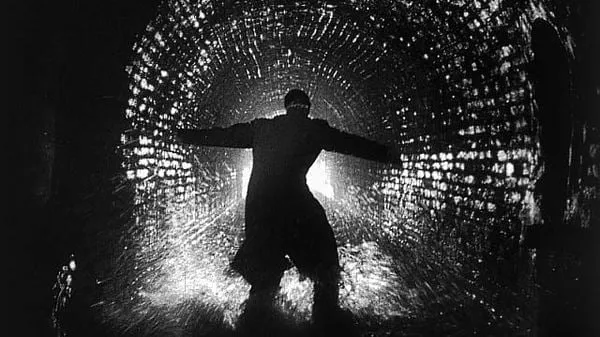
In the gloomy streets of Vienna, amid the rubble, the footsteps of Holly Martins, a writer of cheap adventure novels, echo. Against the pale backdrop of postwar Austria, fueled by the black market, he tries to uncover the truth behind the suspicious death of his old friend, Harry Lime.
Directed by Carol Reed, this black-and-white thriller weaves a sinister web of conspiracy that stretches from the shadow of a giant Ferris wheel to the dark labyrinth of the sewers. Conducted in the shadow of British military patrols and forged passports, this investigation into a missing person draws the viewer into a tense chase at every turn.
7. Touch of Evil (1958) – Orson Welles
In that dusty town on the Mexican border, the explosion that suddenly tears through the sky does more than just cut short a newlywed couple’s honeymoon. In this crime-thriller spiral, woven into black-and-white frames, Orson Welles masterfully lays bare the dark divide between two countries and the border lines erased by justice. The investigation that begins in the wake of a car explosion pits a corrupt police captain against an official determined to uncover the truth. Amid the town’s hotels, seedy streets, and gang showdowns, the power struggle between the two sides grows increasingly suffocating. In this dark world beneath the sun and dust, the concept of justice is melting away a little more with every passing moment.
8. The Big Sleep (1946) – Howard Hawks
A smoky office gliding through the rainy streets under the artificial lights of Los Angeles. This classic film noir by Howard Hawks follows the journey of a detective set out to find the young daughter of a wealthy family who has fallen into a downward spiral. Blackmail letters, gambling debts, and murders committed in back alleys all intertwine. Philip Marlowe encounters a new mystery around every corner. As the mysteries waiting to be solved stretch out beneath the streetlights, the tension steadily rises.
9. Laura (1944) – Otto Preminger
That portrait adorning the wall of a luxurious apartment insidiously seeps into the minds of everyone in the room. The silhouette of the murdered woman is the only fact guiding the steps of the detective leading the investigation. Otto Preminger constructs a puzzle woven with shadows within the black-and-white film noir aesthetic of the 1940s.
As the detective examines the victim’s past and the suspicious portrait she left behind, the boundaries of truth begin to blur. In the dark corridors of the homicide division, jealousy and obsession completely alter the course of the investigation. The fascination with this enigmatic woman at the center of the crime makes maintaining a professional distance impossible.
10. Memento (2000) – Christopher Nolan
Set against the backdrop of Los Angeles, this neo-noir atmosphere seeps into the mind of a man wandering the streets with Polaroid photos in his hands and clues tattooed on his body. Christopher Nolan reverses the flow of time as he follows Leonard, who suffers from amnesia; this backward-unfolding puzzle draws the viewer into the character’s disoriented state of mind. In this dark hunt that stretches from motel rooms to police stations, as each new tattoo attempts to part the fog of the past, the truth itself grows even more blurred.
11. Se7en (1995) – David Fincher
Under that gloomy, relentless rain, the city envelops you in a suffocating atmosphere that makes it impossible even to breathe. In this neo-noir crime thriller directed by David Fincher, the streets are littered with the traces of a mind that has made the darkest corners of humanity its home. A weary detective and his impatient partner strive to unravel the logic behind murders committed with the dogmatic brutality of the seven deadly sins. Each new crime scene serves as a disturbing mirror held up to the city’s rotten conscience.
12. The Usual Suspects (1995) – Bryan Singer
In the dim, cigarette-smoke-filled interrogation room of the Los Angeles police headquarters, the story begins amid the rubble left behind after a harbor explosion reduced everything to ashes. Directed by Bryan Singer, this neo-noir film unfolds as an eerie puzzle, told through the eyes of the sole survivor, with clues intertwining to form a complex mystery. Spanning from the streets of New York to the California coast, this dark criminal conspiracy traces the trail of a notorious criminal mastermind hiding in the shadows, while exposing the corruption within the police force itself. As each statement bends the truth a little further, it drags those at the table—and us—into a dead end filled with mind games.
13. In Bruges (2008) – Martin McDonagh
Amid medieval Gothic towers and dark canals, this picture-perfect Belgian town is home to two hired killers weighed down by the gravity of their crime. This dark comedy by Martin McDonagh centers on a moral reckoning that echoes through the historic streets adorned with Christmas lights. As Ray and Ken await their next order from their boss, they are left alone with the guilt seeping through the stone walls. The town’s peaceful atmosphere stands in stark contrast to the killers’ tense wait. Encountering the ghosts of the past at every turn, the pair is still unaware that the order they’re waiting for will completely change their lives.
14. Chinatown (1974) – Roman Polanski
On the sun-scorched streets of Los Angeles, dust clouds and hot winds are ever-present. Private detective Jake Gittes struggles to find his way amid shifting alliances and dark secrets. The world he steps into to solve what seems like a simple case of infidelity quickly turns into the center of a complex web of conspiracy.
Directed by Roman Polanski, this neo-noir thriller centers on the sordid relationships driven by the pursuit of water and power. As the hidden face of the aristocracy slowly comes to light in the arid lands of California, a new danger lurks around every corner. Gittes is forced to push his own limits as he pursues the truth.
15. Motherland Hotel (1987) – Ömer Kavur
At the Anayurt Hotel, buried in the silence of the countryside, time flows slowly, like a rusty clock. In this world, where Ömer Kavur masterfully blends suspense and drama, the monotonous days of Zebercet, the hotel clerk, are disrupted by an unexpected event. That mysterious woman, who comes and goes for just one night, stirs up a quiet upheaval in the midst of provincial solitude. Whispers seeping from the rooms and the creaking of the wooden stairs fuel the unease lurking beneath the surface of ordinariness. The void left behind by the departing guest pries open the door to the mind’s darkest recesses.
16. Sunset Boulevard (1950) – Billy Wilder
On the sun-drenched boulevards of Los Angeles, silence has settled over a faded grandeur. This dark drama, directed by Billy Wilder, whispers the story of a struggling screenwriter whose path crosses that of a diva on the verge of being forgotten behind the bright lights, in an abandoned mansion.
In this world woven with the ghosts of a glorious past, the boundaries of reality blur. The dangerous obsession of a star forgotten by time transforms into an eerie shadow echoing through the ruthless streets of Los Angeles.
17. Pi (1998) – Darren Aronofsky
Amid the concrete jungles of New York, a man struggling to endure the buzzing inside his throbbing skull. In the eerie atmosphere created by black-and-white frames, Darren Aronofsky paints a portrait of a genius trapped between the absolute order of mathematics and the fragile limits of the human mind.
Pages upon pages of number sequences, complex codes flickering on screens, and that constant headache gnawing at his mind. This mysterious and tense journey conveys, in a resonating state of mental disintegration, how a mathematician striving to decipher the universe’s code slowly severs his connection to reality.
18. Donnie Darko (2001) – Richard Kelly
The quiet of the 1980s suburbs is shattered by an airplane engine falling from the sky and the strange void it leaves behind. In this film by Richard Kelly, the tension of high school hallways and family dinners is warped within the mind of a teenager who sleepwalks. Navigating between mental breakdowns and fantastical elements, this mysterious atmosphere draws the viewer into a puzzle that pushes the boundaries of reality. The whispers of an invisible rabbit costume gradually transform the ordinariness of the suburbs into a surreal nightmare. An eerie journey that, as it gets lost in the labyrinths of a young mind, makes one feel just how fragile time and parallel universes truly are.
19. Akira (1988) – Katsuhiro Otomo
On the neon-stained asphalt of Neo-Tokyo, the concrete awakens with a crackle amid the roar of motorcycle gangs. Katsuhiro Otomo brings the violence and decay echoing through the streets of this vast metropolis to the screen with a tension that pushes the boundaries of animation. As the devastation wrought by secret military experiments on human flesh drives the city to the brink of utter catastrophe, the dystopia subtly takes hold of minds.
Every screech of brakes echoing among the piles of metal is a harbinger of the approaching apocalypse. In this dark universe woven from the rawest form of science fiction aesthetics, the underground struggle of young street gangs spirals out of control. As unchecked power rages, Neo-Tokyo finds itself trapped between rising from its own ashes or being completely wiped out.
20. Jacob's Ladder (1990) – Adrian Lyne
All that remains of the hell that was Vietnam is a suffocating nightmare gnawing at his mind on the streets of New York. As Jacob Singer searches for the truth amid the hallucinations caused by his post-traumatic stress disorder, the people and places around him begin to melt away and become distorted, one by one. Directed by Adrian Lyne, this tangled web of mystery and drama lays bare the breathless struggle of a veteran lost in the darkest recesses of his mind. This paranoid journey, stretching from subway tunnels to dimly lit streets, takes place in an eerie world where memories and nightmares blur together. As Jacob struggles to hold on to his sanity, the ghosts of his past continue to close in on him from every corner.
21. The Big Lebowski (1998) – Joel Coen, Ethan Coen
The Dude, whose biggest concerns in the Los Angeles heat are an ice-cold White Russian and Thursday tournaments at the bowling alley, one day finds himself in the middle of an absurd case of mistaken identity. His quest to recover his ruined rug—the result of a senseless raid on his home—drags him into the complex world of nihilists and local billionaires.
In this crime-comedy whirlwind directed by the Coen brothers, our unemployed hero and his loyal friends embark on a rusty adventure to avenge the rug. Echoing through the dusty streets of California, this tale of aimlessness shows how ordinary moments can spiral into chaos.
22. Brazil (1985) – Terry Gilliam
Imagine an office life trapped between the clatter of radiator pipes and mountains of paperwork. In this dark comedy universe, Terry Gilliam paints a picture of a future ruled by gray desks and absurd bureaucracy. Sam Lowry is an ordinary civil servant, lost in the cogs of the system, who constantly escapes the monotony of the day by retreating into his dreams. As reality and dreams blur, he struggles to find his way within a massive state apparatus. Set against a backdrop of steam, cables, and strange machines, this dystopia leaves the viewer in the middle of a Kafkaesque labyrinth. This journey, marked by misunderstandings and chaotic outbursts, lays bare the absurdity of the system.
23. Blade Runner (1982) – Ridley Scott
A Los Angeles night, battered by acid rain and made up entirely of neon. This dystopia, directed by Ridley Scott, creates a universe struggling to breathe amid man-made bodies and fading lives. The streets, trapped beneath the hum of flying vehicles, are filled with shadows that whisper about who is truly human.
For a bounty hunter, every breath taken beneath the streetlights is suspect. In this sci-fi thriller, which embodies the darkest shades of the tech-noir aesthetic, fugitives and their pursuers alike are lost within the same rusted dream. In this world where boundaries have dissolved, simply existing is, in itself, a quest for proof.
24. 25th Hour (2002) – Spike Lee
The final twenty-four hours before the start of a seven-year prison sentence hang over the streets of New York like a heavy shadow. In this crime-drama directed by Spike Lee, a drug dealer finds himself trapped between his glittering past and the inevitable fate that awaits him. Amid the city’s dusty and weary atmosphere, friendships, suspicions, and shattered dreams surface one by one. The silent reckoning of a closing era and those left behind flows quietly in the darkness of the night, in time with the rhythm of the street.
25. 2001: A Space Odyssey (1968) – Stanley Kubrick
A jet-black rock emerging from the moon’s surface takes humanity’s silent journey through the void of space to an entirely new dimension. Directed by Stanley Kubrick, this classic adventure centers on a long-haul journey toward Jupiter. As the tension between the ship’s intelligent supercomputer and the astronauts slowly escalates, technology evolves into a dangerous threat to humanity. This sense of the unknown in the midst of the void succeeds in captivating the mind with a deep sense of wonder.
26. Crash (1996) – David Cronenberg
As the heat of the asphalt mingles with the cold of the metal, that pile of scrap by the side of the highway opens the door not just to a moment of an accident, but to an entirely different desire. Directed by David Cronenberg, this journey of suspense and drama forges a new language at the intersection of body and machine. The eerie pull of traffic accidents drags the characters toward the city’s underground dead ends. Scrap metal and fresh wounds become expressions of repressed urges. Every screech of brakes etches itself into the mind like an eerie whisper echoing through hospital corridors. In these dark streets, where eroticism and destruction are so deeply intertwined—and which pull the viewer out of their comfort zone—the mechanized passions of the modern world are not explicitly revealed, but merely felt.
Related Movements & Themes
120k reads
Klasik Filmler Listesi
221k reads
Kült Filmler Listesi
1.7k reads
Alman Dışavurumculuğu
1.9k reads
Fransız İzlenimcilik
Home
Film
Curation
Criticism
Menu