List of War Movies
0
Films
0 min.
Read Time
0k
Views
The "KültAlt" War Movies List aims to highlight how humanity is put to the test by war, its most destructive creation. Rather than a visual feast, what you’ll find in each film is plenty of blood, death, psychological trauma, massacres, and perversion at the highest levels of authority.
BM
Bahadır Mahmut
Curator
Related Movements & Themes
221k reads
Kült Filmler Listesi
120k reads
Klasik Filmler Listesi
About the Film List
Generally speaking, what is expected of war films—due to the commercial concerns of mainstream cinema—is that what appears on screen becomes both a visual feast and, at the same time, an exercise in emotional manipulation. Mainstream cinema has thus found a rational way to convey the concept of war to its audience without causing discomfort. This approach has also been accepted by mainstream audiences, who do not wish to be challenged under any circumstances. Consequently, the fact that something as unsettling as war is received with satisfaction by the audience is a clear indication of just how little of the concept of war actually remains within the film.
The Human Element
The films that make up the war film list generally focus on people. These are people who die, give orders to kill, kill others, and—without exception—find themselves in psychological dilemmas whenever they survive.
Character Transformation
In these films, war is such a powerful narrative force that no one who enters it remains the same. The war machine grinds everyone down, changes them, and transforms them without exception. For this reason, character development is one of the most prominent features in the films listed below.
Best Of
Selection List
Curator's Order
1. The Hill (1965) – Sidney Lumet
That hill stretches out in the middle of the scorching Sahara Desert, beneath the bone-crushing North African sun. Built by the British Army with their own hands while World War II was still raging, this military prison tests people’s endurance not so much with the enemy as with the cruelty within its walls. Directed by Sidney Lumet, this drama centers on the soldiers’ struggle against the sand dunes that turn their every step into torture.
In this hell where heat and loneliness gnaw at the mind, sadism cloaked in the guise of discipline drives the prisoners to the brink of exhaustion. Every order echoing through the sands of the hill becomes an instrument of punishment that slowly grinds down their spirits.
2. Hiroshima Mon Amour (1959) – Alain Resnais
A makeshift shelter built amid the ruins. In this Japanese city cast in the shadow of war, two strangers whose paths cross far from the cameras’ gaze confront the ghosts of the past. As a woman from France and a married Japanese architect weave their words together atop the rubble, the concept of time slowly dissolves.
Alain Resnais’s black-and-white palette delicately captures the forbidden and painful memories etched into the skin of these two people. Every glance bears the trace of another land left behind and of wounds that will never heal.
3. The Mouse That Roared (1959) – Jack Arnold
A tiny European duchy on the verge of being wiped off the map finds a way to save its treasury by declaring war on the United States and surrendering immediately. The plan is simple: Lose the war, tap into American aid funds, and live in prosperity. Jack Arnold presents a timeless comedy that blends this absurd premise with all the hysteria of the Cold War era. Things go completely off the rails when a handful of soldiers—clad in medieval armor and armed with bows and arrows—set foot on the streets of New York City.
Those empty, eerie New York streets—where residents have fled to shelters due to a nuclear drill—now serve as a haven for this bizarre invading army. The film is a sharp example of satire targeting the nuclear paranoia of the era and the hollow arrogance of global politics. Combining the absurdity of war with the ridiculousness of military ceremonies, the film offers viewers a cleverly crafted experience that pokes fun at the political climate of the time.
4. Dr. Strangelove or: How I Learned to Stop Worrying and Love the Bomb (1964) – Stanley Kubrick
In the dim light of the war room, diplomats and military officers poring over maps are searching for a solution on the brink of apocalypse. The nuclear crisis, triggered by a single order from the general, transforms into a biting satire that blends Cold War paranoia with bureaucracy and absurdity.
Stanley Kubrick echoes the end that humanity has brought upon itself with his own hands in black-and-white tones on the screen. This cinematic nightmare, which blends elements of comedy and war, exposes the system’s jammed gears and helplessness with mocking detachment.
5. The Great Dictator (1940) – Charlie Chaplin
The sound of scissors echoing through the narrow streets of the Tomanian ghetto is lost amid the gears of a vast world on the brink of collapse. In this life cast under the shadow of war and fascism, the fates of an ordinary barber and a dictator sworn to conquer the world intersect through an incredible coincidence. In this comedy-war film, where Charlie Chaplin brings humor and war together on the same set, he brings to the screen how the machinery of propaganda and social paranoia grinds humanity down. Every gesture that emerges from the black-and-white imagery is part of both an absurd sensibility and a sharp satire that raises its voice against authority. The barber’s reflection in the mirror, caught in the midst of the chaos, whispers just how close power and wretchedness really are.
6. The Deer Hunter (1978) – Michael Cimino
The smoke rising from Pennsylvania’s gloomy steel mills mingles with memories of quiet hunting trips in the woods. Michael Cimino’s unforgettable drama examines the lives of a group of working-class friends as they step into the devastating shadow of the Vietnam War. As the joyful crowds in wedding halls give way to dark rooms in the midst of hell, the bonds of friendship face their toughest test.
7. Johnny Got His Gun (1971) – Dalton Trumbo
The din of World War I suddenly falls silent, leaving behind only a body left alone with its own heartbeat. Directed by Dalton Trumbo, this harrowing war drama focuses on the dark world of a young infantryman who has returned from the front lines. A man who has lost his arms and legs, as well as his sight and hearing, is trapped within his still-intact mind.
Cut off from the outside world, this man oscillates between his memories and the reality of the moment. The coldness he feels on the examination table and the starkest form of existence leave the viewer, too, in the very center of this silence.
8. Jacob's Ladder (1990) – Adrian Lyne
All that remains of the hell that was Vietnam is a suffocating nightmare gnawing at his mind on the streets of New York. As Jacob Singer searches for the truth amid the hallucinations caused by his post-traumatic stress disorder, the people and places around him begin to melt away and become distorted, one by one. Directed by Adrian Lyne, this tangled web of mystery and drama lays bare the breathless struggle of a veteran lost in the darkest recesses of his mind. This paranoid journey, stretching from subway tunnels to dimly lit streets, takes place in an eerie world where memories and nightmares blur together. As Jacob struggles to hold on to his sanity, the ghosts of his past continue to close in on him from every corner.
9. Come and See (1985) – Elem Klimov
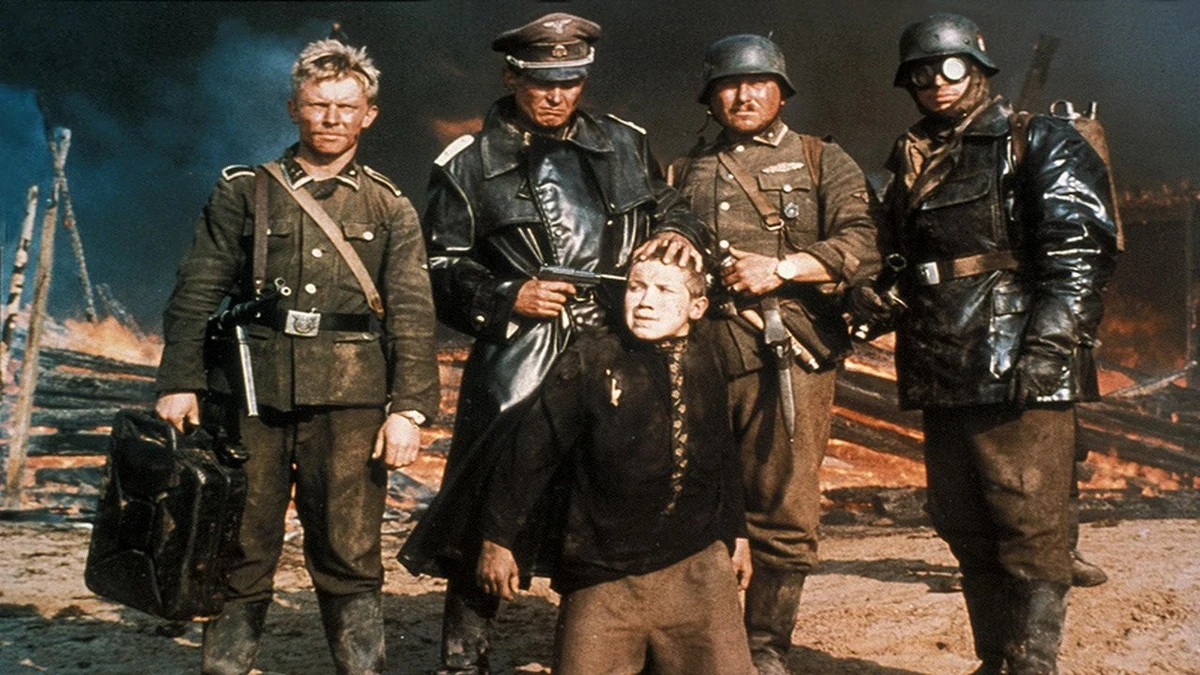
The footsteps echoing across the muddy lands of Belarus blur the fine line between childhood and hell. Directed by Elem Klimov, this harrowing drama centers on the gradual descent into madness of a young boy who joins the resistance with a rusty rifle under the devastating shadow of World War II.
The deathly silence left by the Nazi occupation in the villages merges with the struggle for survival deep in the forest. Through surrealist shots and the journey taken alongside Glasha, a young girl caught in the midst of inhuman brutality, the film drags the viewer into one of history’s darkest corners—a witness to a reality from which there is no return.
10. Patton (1970) – Franklin J. Schaffner
That stern gaze beneath the massive steel helmets brings the gray dust of war and the coldness of steel directly to the screen. Franklin J. Schaffner navigates the boundaries of victory and hubris as he paints a portrait of a controversial military genius caught in the gears of World War II. Spanning from the scorching sands of North Africa to the muddy roads of France, this historical drama lays bare the inner battle raging in the mind of a stubborn commander who changed the course of history. *Patton* addresses the reckonings behind the front lines and the fates crushed beneath tank tracks with an unvarnished sense of reality.
11. Schindler's List (1993) – Steven Spielberg
The gray dust blanketing the streets of Kraków and the echo of stones beneath the boots of SS officers reveal an eerie order established in the midst of war. The black-and-white images, rather than obscuring an inhuman brutality, transform it into an even more stark reality.
Oskar Schindler, a merchant and industrialist in German-occupied Poland, slowly comes face to face with a different reality in this bleak world he entered in search of cheap labor. Amid the smoke rising from the concentration camp’s chimneys, as he witnesses people struggling to survive within the factory’s machinery, his greed for profit gives way to a different struggle for survival.
Set against the harshest and most tense backdrop of historical drama, this narrative shows that a space for resistance can be created even in the darkest of rooms. Every name written in Schindler’s list is a silent step taken in the midst of hell.
12. Kurtulus (1994) – Ziya Öztan
While the land lies shrouded in a heavy silence, a resistance dating back thousands of years is being woven anew in dilapidated rooms and along rugged paths. In this land, where deprivation and helplessness encircle it like an iron ring, people are fighting for survival by sharing the last piece of bread and the last shred of hope they have left. This historical and war narrative by Ziya Öztan centers on the quiet, weary breaths behind great victories—the human reality that lies beyond maps and battlefronts. The story of those who refused to be crushed by the gears of imperialism is brought to the screen in a simple, unadorned language—free from grandstanding and jingoism. The profound weight felt at every step leaves the viewer right in the midst of one of history’s most fragile moments.
13. Full Metal Jacket (1987) – Stanley Kubrick
The echoing shouts of the drill sergeants and the endlessly repeating obstacle courses are the first step in transforming young bodies into killing machines. In this drama centered on the human-grinding machinery of the Vietnam War, Stanley Kubrick lays bare the cold face of deep-rooted militarism.
On this journey stretching from the suffocating dust of the training camp to the ruins of Hue’s streets, the minds of the infantrymen are slowly shattered. Overshadowed by military discipline and propaganda, these individuals are forced to leave their humanity behind amid the jungle and the fighting.
14. Kagemusha (1980) – Akira Kurosawa
In the late sixth century, on the blood-soaked battlefields of the Sengoku period, the balance of power hangs by a thread. In this historical epic, Akira Kurosawa plunges the audience into the midst of the clang of swords and strategic maneuvers. An ordinary thief, thrust into the role of a powerful leader on the brink of death, gradually transcends his mere status as a figurehead and begins to feel the weight of the throne on his shoulders. The harrowing reality of the battlefields and the rigid rules of the feudal order make it increasingly difficult to sustain this dangerous game with each passing day. As the army marches toward its inevitable end, the line between identity and power slowly blurs.
15. Aguirre, the Wrath of God (1972) – Werner Herzog
On the trails of the sixteenth century, Spanish conquistadors descending from the Andes beneath the clouds step into a green hell in search of lost treasures. Directed by Werner Herzog, this historical adventure brings the somber atmosphere aboard a raft navigating the dark waters of the Amazon River directly to the audience.
Amid the ruins left behind by the fall of the Inca Empire, greed and madness slowly gnaw away at human will. Led by Don Lope de Aguirre, this relentless quest is swept along by the river’s current toward a point of no return.
16. Apocalypse Now (1979) – Francis Ford Coppola
The sound of the boat’s engine as it moves along the river mingles with the putrid stench of the swamp and the distant hum of helicopters. In the midst of the war, a captain who has set out on a secret mission—one not mentioned in official records—is drawn deeper into the mist-shrouded forest. Francis Ford Coppola isn’t telling an ordinary frontline story set against this backdrop of drama and war. On the contrary, this journey to find a colonel who has lost his sanity turns into a dangerous nightmare that delves into the darkest corners of the human mind. As everything around him loses all sense of reason, the silence along the riverbank continues to serve as a harbinger of the approaching storm.
Related Movements & Themes
221k reads
Kült Filmler Listesi
120k reads
Klasik Filmler Listesi
Home
Film
Curation
Criticism
Menu